Posts

Showing posts with the label 29er

Douze idées pour développer une équipe provinciale de voile jeunesse au Québec (Partie 2)

Image
Ceci constitue la suite de l’article présentant douze idées pour développer une équipe provinciale au Québec. La première partie, si vous ne l’avez pas encore lue, est accessible à ce lien . Un développement est survenu depuis: la publication de la version officielle du projet d'équipe provinciale de la fédération. Ce document a été transmis par la fédération malgré d’évidentes faiblesses et le peu de consultations dont il a fait l’objet. Ceux qui disposent du document de la fédération pourront constater que l’approche préconisée est très différente de ce qui est suggéré ici - avec notamment pour différences le rôle de l’Optimist, le nombre, la destination et le coût des déplacements en hiver et au printemps, et le type de structure proposé pour soutenir les athlètes. Bien que les parents aient à répondre d’ici deux semaines, espérons que des ajustements pourront être faits pour améliorer le projet de la fédération, qui semble présentement susciter plus de questionnements que d...
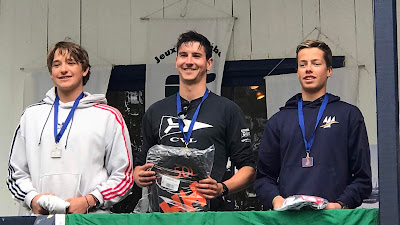
Championnats du Québec 2019 de Voile Jeunesse: les Résultats

Image
Le podium en Laser Radial: 1. Victor Sullivan 2. Calem Austin 3. Francis Charland Les championnats 2019 de voile jeunesse se sont déroulés, comme à l’accoutumée, au Club de Voile des Deux Montagnes, les 7 et 8 Septembre 2019. Ce sont quelques 130 concurrents qui y ont participé. Voici les podiums pour les différents types d’embarcation et catégories d’âge - lorsqu’appliquable. Pour consulter les résultats complets, voir le lien : Optimist (classement général) 1. Mathieu Graham 2. Carlos Charabati 3. Jacob Towsend Optimist (flotte rouge) 1. Mathieu Graham 2. Jacob Towsend 3. Noé Portelance Optimist (flotte bleue) 1. Carlos Charabati 2. Nicolas Absi 3. Angus Beauregard Optimist (flotte blanche) 1. Eva Doucette 2. Benjamin Port-Louis 3. Nathaniel Stoner Topper 1. Gabriel McGrow Edmunds 2. Chloë Scheunert 3. Benjamin Rinfret-Racette Laser Radial 1. Victor Sullivan (senior) 2. Calem Austin (U16) 3. Francis Charland (U19) Laser Radial (U16) 1. Calem ...

Douze idées pour développer une équipe provinciale de voile jeunesse au Québec (partie 1)

Image
Cela fait maintenant quelques années que l’on parle de reconstituer une équipe provinciale de voile jeunesse au Québec. Voici quelques idées pour le faire, qui sont non seulement adaptées à la situation particulière au Québec, où la voile de compétition est un sport peu pratiqué, mais qui reposent aussi sur les méthodes utilisées là dans le monde où l’on produit régulièrement des athlètes de haut niveau. Ces idées portent essentiellement sur les jeunes de 12 à 18 ans et visent à les faire réussir sur le plan sportif, sans porter préjudice à leur scolarité, qui devient typiquement de plus en plus exigeante au fur et à mesure que les années avancent. Les considérations abordées sont diverses, du choix des embarcations à la planification annuelle et au contrôle des coûts. Ces idées sont le fruit de multiples discussions et réflexions sur le sujet au cours des dernières années. Elles forment toutefois un ensemble cohérent, visant à susciter l'engouement des athlètes, des entraîneurs...

Twelve Ideas for Developing a Provincial Youth Sailing Team in Québec (Part 2)

Image
VII. Extend the Sailing Season with Training in New England If the sailing season is particularly short in Quebec, it is less so just a few hundred kilometers away, in New England. Already, some athletes from Quebec are training there, for example at the excellent Sail Newport public sailing center in Rhodes Island (see picture). Extending the sailing season for Quebec athletes is fortunately possible by organizing long weekends of training and / or competitions in New England. For example, by missing only two school days on Thursday and Friday, it is possible to have a departure on Wednesday evening by road, and a return on Sunday at the end of the day. From Montreal, it's about 600 km of road and it's very feasible. Logically, the idea would be to have an agreement with Sail Newport or another similar center to bring the boats in the fall, once it is no longer possible to practice in Quebec, and leave the boats there, to organize for example 2 long week...

Twelve Ideas for Developing a Provincial Youth Sailing Team in Québec (Part 1)

Image
For a few years now, there has been talk about reconstituting a provincial youth sailing team in Quebec. Here are some ideas for doing so, which are not only adapted to the situation in Quebec, where competitive sailing is a little practiced sport, but which also rely on the methods used where high performance athletes are regularly produced. These ideas focus on youth sailors aged 12 to 18 and aim at making them more successful without hurting their schooling, which typically becomes more demanding as the years go by. The considerations discussed here are diverse, from the choice of boats to annual planning and cost control. These ideas are the result of many discussions and reflections on the subject in recent years. They aim at offering practical solutions that address the needs of athletes, coaches, parents, as well as club and provincial officials. Find here the original document in French. Trouvez ici la version originale en français. ————————————————— CONTENTS I. Strat...

Top USA Optimist Sailor Wins Fall CORK in the Laser 4.7

Image
There was a surprise registration at Fall CORK in the Laser 4.7 fleet: Cort Snyder, from the Lauderdale Yacht Club in Florida, who won the prestigious Orange Bowl regatta in the Optimist in December last year, and who placed 4th overall at the Garda meeting in 2018, with over 1000 participants. Canadian Laser 4.7 sailor Noah Adler in action The Fall CORK regatta (CORK stands for Canadian Olympic-training Regatta, Kingston) was a 2 day event, held this year in summer like conditions. First day were light winds, and only 2 races were possible. For the second day, there were sustained winds of 12 to 15 knots, and 3 races were completed. Snyder won the regatta in the Laser 4.7 with 3 bullets and 2 second positions. Second in the Laser 4.7 was Noah Adler from Nova Scotia, the 2018 Canadian Optimist champion.  The Laser 4.7 fleet had 19 boats, versus 12 in the Standard and 68 in the Radial, which was won by Canadian sailing team sailor Coralie Vittecoq, from Québec. The standard ...

Sailing after the Optimist - Webinar #1

Image
Optimist sailing is great, but all good things come to an end. Now what to sail after the Optimist? This is the question that will be addressed by Jean-Pierre Kiekens, a recently graduated optimist father, after over 10 years of service in that capacity. He is also very familiar with the Club 420 and Laser Radial as used in youth sailing. Jean-Pierre is not only a sailor (Laser, Snipe, etc.) but he is also running a specialized blog on youth sailing and has written many articles on the challenges associated with youth sailing development, particularly in the North American context. The webinar will discuss what's best to do after the Optimist: - Youth sailing development: what are the goals? - Single-handed or double-handed sailing? Or both? - Laser and C420s: are they still suitable for youth sailors? - Two missing links in youth sailing in North America: the Laser 4.7 and the RS Feva - 29er, i420, Nacra 15, etc.: multiple choices, but few real options - What about windsur...

Fixing the Youth Sailing Pathway with the Laser 4.7 and the RS Feva

Image
2016 4.7 Europeans - Source: EurILCA This past weekend’s Laser Canadian championship was a reminder of the very limited spread of the 4.7 rig in Canada.  Out of a total of 55 participants, there were just 4 competitors in the 4.7. This situation is unfortunately pretty typical not only in Canada but more generally in North America, as the 4.7 rig remains unpopular in the US too. The contrast with Europe is stark. For example, at the 2019 Laser 4.7 European championships held in Hyères, there were nearly 400 participants. In Europe, there is a balance, in youth sailing, in terms of participation between the 4.7 and the Radial. Sailors typically sail there a few years in the 4.7, and then continue in the Radial. Some male athletes pursue afterwards in the Laser Standard. Unlike in Europe, there is no such balance between the 4.7 and the Radial in youth sailing in Canada, and in North America in general. Europe now has huge vibrant fleets of both Lasers 4.7 and Radial, and is ...